
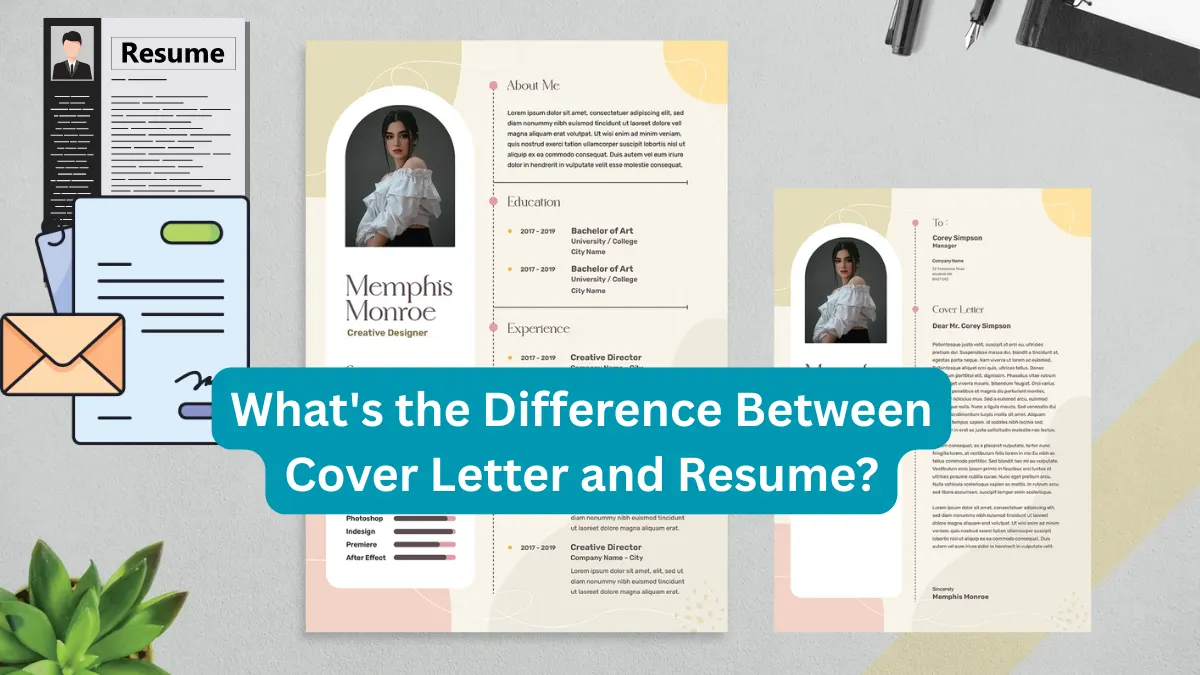
Job seekers often ask what’s the difference between cover letter and resume, especially when an application asks for both. The confusion is understandable. Both documents are about you, both go to the same employer, and both support the same goal. But they do completely different jobs, and submitting one without the other, or treating them as the same thing, weakens your application.
Understanding how each document works, what it contains, and what it is meant to accomplish helps you write both of them better. A resume and a cover letter are not interchangeable. They are complementary. This article breaks down exactly how they differ, when to use each, and what a cover letter can explain that a resume simply cannot.
Must Read: How to Put Study Abroad on Resume
A resume is a structured document listing your work history, skills, and education. A cover letter is a short professional letter explaining why you want the role and what makes you a strong fit. The resume shows what you have done. The cover letter explains why it matters for this specific job.
What’s the Difference Between Cover Letter and Resume: The Core Distinction
The simplest way to frame the difference: a resume presents facts and a cover letter provides context. Both are necessary in a complete job application, but they speak to the hiring manager in different ways.
A resume answers:
- Where have you worked?
- What did you accomplish?
- What skills and qualifications do you have?
- What is your educational background?
A cover letter answers:
- Why do you want this specific role?
- Why do you want to work at this company?
- What in your background makes you the right fit?
- Is there anything in your resume that needs explanation?
When you know what’s the difference between cover letter and resume at this level, you stop repeating yourself across both documents and start using each one for what it does best.
Side-by-Side Comparison: Cover Letter vs Resume
| Feature | Resume | Cover Letter |
|---|---|---|
| Format | Structured sections with headers | Prose paragraphs in letter format |
| Length | One to two pages | Three to four paragraphs, one page |
| Tone | Formal, factual, concise | Professional but more personal |
| Purpose | Document your full professional history | Make the case for this specific job |
| Content | Jobs, skills, education, achievements | Motivation, context, fit, personality |
| Bullet points | Yes, standard format | No, written in full sentences |
| Customization | Tailored to each job type | Tailored to each specific job and company |
| ATS scanning | Yes, heavily scanned | Sometimes scanned, varies by employer |
| Required | Almost always | Often required, sometimes optional |
| Written to | Whoever reads it | A specific person or hiring team |
This table captures how is cover letter different from resume at a structural and functional level. Both documents should be tailored, but the cover letter demands more specificity because it addresses one employer directly.
What Goes in a Resume
A resume is a professional document that records your career history in a structured format. Most resumes include these sections:
- Name and contact information at the top
- Resume headline or summary stating your professional identity and key qualifications
- Work experience listed in reverse chronological order with bullet points showing achievements
- Education including degrees, institutions, and graduation dates
- Skills covering technical, language, and other hard skills
- Optional sections such as certifications, volunteer experience, publications, or awards
Each section uses consistent formatting. Bullet points keep entries scannable. The goal is to give a hiring manager or ATS system a clear, complete picture of your professional background quickly.
A resume does not explain gaps, express enthusiasm for the company, or tell a story. It records facts. The cover letter handles everything else.
What Goes in a Cover Letter
A cover letter is a one-page professional letter addressed to the hiring manager or team. It has three to four paragraphs and follows a clear structure:
- Opening paragraph: State the role you are applying for and one direct reason why you are a strong fit. Skip generic openers like “I am writing to apply.”
- Body paragraph one: Highlight one or two specific experiences from your resume that are most relevant to this role. Add context that the resume does not carry. Explain what you did, why it mattered, and how it connects to this job.
- Body paragraph two (optional): Address the company directly. Show that you researched them. Connect your background or values to something specific about their work, mission, or market position.
- Closing paragraph: State your interest clearly, note that you have attached your resume, and invite next steps. Keep it direct and confident.
A cover letter does not list every job you have held or repeat your resume line by line. It picks two or three points from your background and builds a targeted argument around them.
Also Read: How to Include Languages on Resume
What Can a Cover Letter Explain That a Resume Cannot
This is where the two documents diverge most clearly. What can a cover letter explain that a résumé cannot is one of the most practical questions any job seeker can ask.
Here are the things a cover letter handles that a resume cannot:
Employment gaps A resume shows a gap by the absence of dates. A cover letter can address it directly: “I took 18 months away from the workforce to care for a family member and have since completed a data analytics certification.” One sentence removes the question before it becomes a concern.
Career changes If your resume shows a shift from one field to another, a resume alone looks inconsistent. A cover letter explains the pivot, connects your transferable skills, and frames the change as intentional rather than opportunistic.
Motivation and genuine interest A resume cannot tell a hiring manager why you actually want this job. A cover letter can. And for many employers, demonstrated interest in their company specifically is a real differentiator between candidates with similar qualifications.
Context for unusual decisions Took a step down in title for a better opportunity? Moved from a large company to a startup? Left a prestigious role for a personal reason? A cover letter handles this without apology.
Personality and communication style A resume written in bullet points reveals almost nothing about how you communicate in writing. A cover letter does. Hiring managers read cover letters to assess clarity, tone, and professionalism of thought, not just the content.
Relocation or availability If you are applying from another city or country, the cover letter is the right place to state that you are relocating or willing to do so. Adding this to a resume looks out of place.
Connection to a referral If someone inside the company recommended you apply, name them in the cover letter opening. A resume has no natural place for this.
How Is Cover Letter Different From Resume in Tone and Voice
How is cover letter different from resume in terms of writing style is a practical question that trips up many applicants.
A resume uses:
- Sentence fragments starting with action verbs (“Managed a team of 12,” “Reduced costs by 18%”)
- No personal pronouns (never “I managed” on a resume)
- Consistent parallel structure across all bullet points
- Formal, compressed language with no filler
A cover letter uses:
- Full sentences in first person (“I led the restructuring of our client onboarding process”)
- A more conversational but still professional tone
- Paragraphs that flow and build an argument
- Specific references to the company by name
The shift in voice is intentional. A resume is a record. A cover letter is a direct address to another professional. Write it like a capable person wrote it, not like a template was filled in.
When Is a Cover Letter Required vs Optional
Many job postings say “cover letter optional.” Here is how to read that:
| Application Instruction | What to Do |
|---|---|
| Cover letter required | Always submit one |
| Cover letter optional | Submit one unless the role is very junior or high-volume |
| No mention of cover letter | Submit one if there is a field to attach it |
| Apply via LinkedIn Easy Apply (no upload field) | Skip it; focus on your profile |
| Recruitment agency submission | Ask the recruiter if one is needed |
| Internal company referral | A short cover letter still helps |
“Optional” rarely means “not valued.” Most hiring managers who receive a strong cover letter with an optional submission notice it positively. The candidates who skip optional cover letters are handing a small advantage to the ones who do not.
Do Both Documents Need to Be Customized?
Yes, but in different ways. This is a key part of what’s the difference between cover letter and resume in practice.
Resume customization:
- Adjust your headline and summary to match the job title and key requirements
- Reorder or emphasize bullet points that match the job posting’s priorities
- Mirror keywords from the job description for ATS compatibility
- Keep your core experience consistent across versions
Cover letter customization:
- Write a new letter for each application, not a template with blanks filled in
- Name the company, the role, and a specific reason you want to work there
- Reference a recent company achievement, product, or news item when possible
- Adjust your featured experience to highlight the most relevant two or three points for each role
A resume can be version-controlled across similar roles. A cover letter should feel like it was written for this company on this day. Hiring managers spot generic cover letters immediately.
What’s the Difference Between Cover Letter and Resume in Length
Length expectations are clear and well-established for both documents.
Resume:
- One page for candidates with fewer than 10 years of experience
- Two pages for senior professionals, executives, or technical roles with extensive project history
- Never three pages for a standard job application
- Academic CVs are different and follow separate conventions
Cover letter:
- Always one page
- Three to four paragraphs
- 250 to 400 words is the ideal range
- Never shorter than two paragraphs (too thin to make a case)
- Never longer than one page (signals poor editing)
Both documents should use the same font, header style, and contact information. A matching visual format signals attention to detail and professionalism.
Mistakes That Happen When Candidates Confuse the Two
Knowing what’s the difference between cover letter and resume also means knowing what goes wrong when candidates blur them.
- Repeating the resume in the cover letter. The cover letter is not a prose version of your resume. Do not restate every job. Pick the most relevant points and build an argument.
- Writing a cover letter with bullet points. Bullets belong on a resume. A cover letter written in bullets reads as lazy formatting and breaks the narrative structure the document needs.
- Writing a resume in paragraph form. Paragraphs on a resume are hard to scan and fail ATS systems. Every job entry needs bullet points with quantified achievements.
- Submitting a generic cover letter. A cover letter that could apply to any company defeats its own purpose. If you can remove the company name and it still makes sense, rewrite it.
- Leaving the cover letter blank while attaching the resume. Some applicants attach their resume and leave the cover letter field empty. This wastes the opportunity to address the hiring manager directly.
- Making the cover letter longer than one page. Length signals a lack of editing discipline. One tight, focused page makes a stronger impression than two sprawling ones.
Frequently Asked Questions
Do I need both a resume and a cover letter for every application?
For most formal job applications, yes. Submit both unless the application system has no cover letter field. Even when listed as optional, a well-written cover letter strengthens your application by adding context and motivation that a resume alone cannot provide.
Can a cover letter hurt my application?
Yes, if it is generic, poorly written, or simply restates your resume. A weak cover letter signals poor communication skills. A strong one signals exactly the opposite. Write it carefully or leave the field blank rather than submitting something that works against you.
Should the cover letter match the resume visually?
Yes. Use the same font, header format, and contact information on both documents. Matching formatting looks polished and professional. It also makes it easier for a recruiter to identify your documents when they are printed or saved separately.
Is a resume or cover letter more important?
The resume typically gets read first and carries more weight in ATS screening. But the cover letter often determines which candidates get called in. Both matter. Neither replaces the other. Treat them as equal parts of a single application package.
What’s the right order to write them in?
Write the resume first. Once your experience and achievements are documented clearly, writing the cover letter becomes easier. You can pick the two or three most relevant points from your resume and build the cover letter argument around them.
Can I use the same cover letter for multiple jobs?
Only as a starting template. Every cover letter you submit should be customized to the specific company and role. The structure can stay consistent, but the company name, role title, and specific examples you choose should change with each application.
Conclusion
What’s the difference between cover letter and resume comes down to this: the resume documents your professional history, and the cover letter makes the case for why that history fits this specific job. One without the other leaves the application incomplete. Together, they give a hiring manager everything they need to decide you are worth a conversation.
Write each document for what it does best, keep them both tight and specific, and treat them as a single coordinated package rather than two separate tasks.

Leave a Comment