
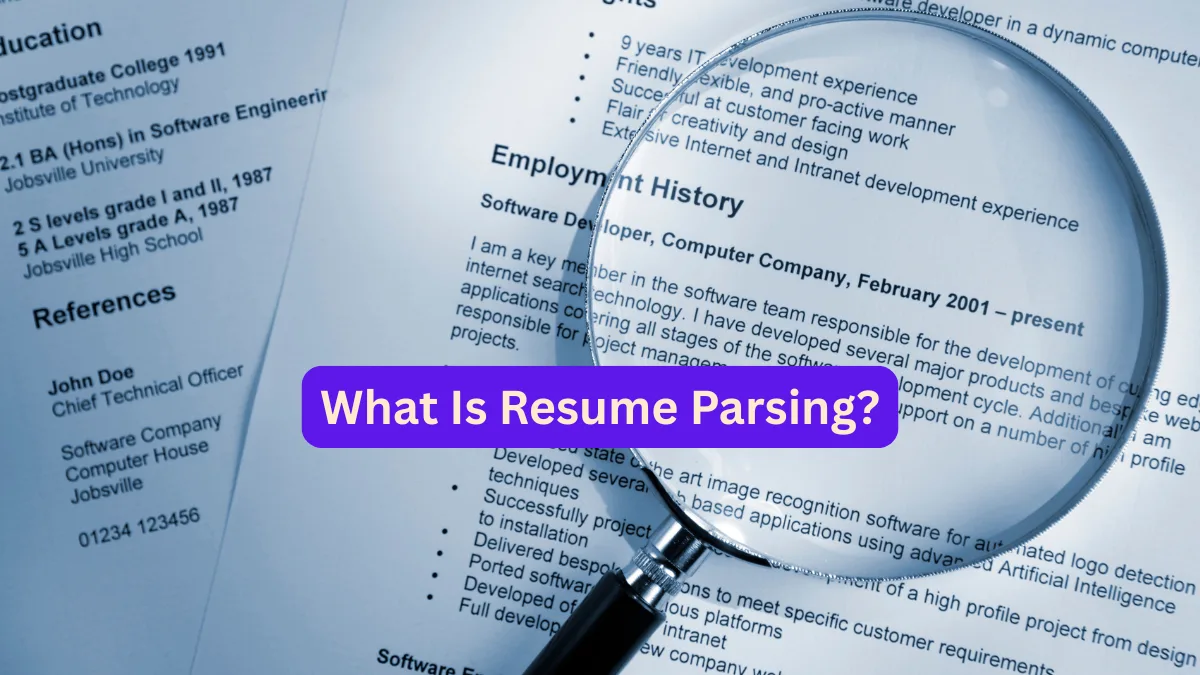
What is resume parsing? It is the automated process of extracting structured data from a resume and converting it into a standardized, searchable format. Resume parsing software reads candidate information, such as name, contact details, work history, education, and skills, then stores that data in fields an applicant tracking system (ATS) or HR database can read. Recruiters no longer need to manually copy details from hundreds of PDFs or Word documents. The parser does it in seconds.
Resume parsing sits at the core of modern hiring workflows. Companies receive hundreds of applications per open role. Without parsing, recruiters spend hours on data entry instead of evaluating candidates. Parsing fixes that. It feeds clean, structured candidate data directly into ATS platforms, speeds up shortlisting, and makes reporting far easier. This guide explains how it works, why accuracy matters, and what to look for when choosing a parser.
Resume parsing is the automated extraction of candidate data, such as name, skills, experience, and education, from a resume file. The parser converts unstructured text into structured fields inside an ATS or HR database, reducing manual data entry for recruiters.
Must Read: How Many Skills Should You List on a Resume
How Resume Parsing Works
Resume parsing follows a clear sequence of steps each time a candidate submits an application.
- File ingestion – The system receives the resume in PDF, DOCX, TXT, or HTML format.
- Text extraction – The parser reads raw text from the file, including content inside tables and columns.
- Section identification – Algorithms locate sections such as Work Experience, Education, and Skills.
- Entity recognition – Named entity recognition (NER) pulls out specific values: job titles, company names, dates, degrees, certifications, and contact details.
- Data normalization – Variations are standardized. “Sr. Software Eng.” becomes “Senior Software Engineer.” Dates convert to a uniform format.
- Field mapping – Extracted values map to predefined fields in the ATS or HRIS.
- Output delivery – The structured candidate record is created and available for search and filtering.
Modern parsers use a combination of rule-based logic and machine learning models. Rule-based systems follow patterns and keywords. ML models learn from large datasets of labeled resumes, which improves accuracy across varied formats, languages, and industries.
Types of Resume Parsing Techniques
Three core methods power what is resume parsing technology today.
| Technique | How It Works | Best For |
|---|---|---|
| Rule-Based Parsing | Uses predefined patterns, keywords, and regex to locate data | Highly structured, templated resumes |
| Machine Learning Parsing | Trains on labeled resume datasets to predict field boundaries | Varied formats, multiple languages |
| Hybrid Parsing | Combines rule-based logic with ML models | Enterprise ATS with diverse applicant pools |
| Semantic Parsing | Understands meaning and context, not just keywords | Skills inference and job matching |
Most enterprise-grade parsers today use hybrid or semantic approaches. Pure rule-based systems fail on non-standard formats. Pure ML systems need large training sets and can miss rare edge cases.
What Data Does Resume Parsing Extract?
A resume parser typically extracts the following categories of information:
Personal and Contact Information
- Full name
- Email address
- Phone number
- Location or address
- LinkedIn URL and other profile links
Work Experience
- Job title
- Employer name
- Employment dates (start and end)
- Job description and responsibilities
- Industry and sector
Education
- Degree name and type (e.g., B.Sc., MBA)
- Institution name
- Graduation year
- Field of study or major
Skills and Competencies
- Hard skills (programming languages, tools, certifications)
- Soft skills
- Language proficiency levels
Additional Sections
- Certifications and licenses
- Awards and achievements
- Publications
- Volunteer experience
The depth of extraction varies by parser. Basic parsers capture contact details and job titles. Advanced parsers infer skills from job descriptions even when not listed in a dedicated skills section.
Why Resume Parsing Matters for Recruiters
Resume parsing delivers concrete, measurable benefits to hiring teams.
Speed. A recruiter manually entering data from one resume takes three to five minutes. A parser processes the same resume in under one second. For a role that draws 500 applicants, that is over 40 hours of manual work eliminated.
Consistency. Manual data entry introduces typos and formatting errors. Parsers apply the same extraction logic to every file, producing consistent records across the database.
Searchability. Structured data is searchable. Once parsed, recruiters can filter candidates by skill, title, location, or education. Unstructured PDF text cannot be filtered this way.
Reduced bias in screening. Structured fields allow recruiters to search on objective criteria rather than reading resumes in sequence, which can reduce unconscious pattern-matching.
Compliance and reporting. HR teams need accurate data for EEOC reporting, headcount planning, and audits. Parsed records are far more reliable than manually entered ones.
Common Challenges in Resume Parsing
Even strong parsers face limitations. Knowing these helps you set realistic expectations.
- Non-standard formats – Heavily designed resumes with graphics, icons, and multi-column layouts break many parsers.
- Scanned documents – A scanned resume is an image, not text. The parser needs OCR (optical character recognition) to read it first.
- Unusual section headers – A section labeled “Where I Have Worked” instead of “Experience” can confuse rule-based parsers.
- Gaps and overlaps in employment – Freelance work, career gaps, or overlapping roles can cause date parsing errors.
- Abbreviations and jargon – Industry-specific shorthand may not map correctly without a robust ontology.
- Multiple languages – Most parsers perform well in English. Accuracy drops for resumes in Arabic, Japanese, or mixed-language formats unless the vendor specifically supports them.
Accuracy rates vary widely across vendors. A 90% field-level accuracy rate sounds high, but across 10 fields per resume, it means one error per application on average.
Resume Parsing vs. Resume Screening: Key Differences
These two terms are often used interchangeably, but they describe different processes.
| Feature | Resume Parsing | Resume Screening |
|---|---|---|
| Primary function | Extracts and structures data from a resume | Evaluates a resume against job criteria |
| Output | Structured data fields in a database | Pass/fail or ranked candidate list |
| When it runs | At application submission | After parsing, during review |
| Technology used | NLP, OCR, ML extraction models | Matching algorithms, scoring rules |
| Recruiter involvement | None required | Can be automated or manual |
Resume parsing enables resume screening. You cannot filter or score candidates without structured data. Parsing comes first; screening uses the parsed output.
How Resume Parsing Integrates with an ATS
What is resume parsing without an ATS to receive the data? In most cases, they work together from the moment a candidate applies.
Here is a typical integration flow:
- Candidate submits application via career page or job board.
- ATS receives the file and sends it to the parsing engine (built-in or via API).
- Parser returns structured JSON or XML data.
- ATS maps the data to candidate profile fields.
- Recruiter views a complete candidate record without typing anything.
Major ATS platforms, including Workday, Greenhouse, Lever, iCIMS, and Taleo, either include a native parser or connect to third-party parsing APIs such as Sovren, Textkernel, or HireAbility. Companies building custom hiring platforms can integrate parsing via REST API.
How to Evaluate a Resume Parsing Solution
Not all parsers deliver the same results. Use this checklist when comparing vendors.
- Accuracy rate – Ask for field-level accuracy benchmarks, not overall accuracy. A single number hides weak spots.
- Format support – Confirm support for PDF (text and scanned), DOCX, RTF, and HTML at minimum.
- Language support – If you hire globally, test on resumes in the languages your candidates submit.
- Skills ontology – Check how the parser maps skills. Does it recognize synonyms? Does it update its taxonomy regularly?
- Integration options – REST API, webhooks, and direct ATS connectors reduce implementation time.
- Compliance – GDPR and CCPA compliance matters if you process EU or California resident data.
- Processing speed – For high-volume hiring, batch processing speed determines how quickly candidates appear in your ATS.
- Vendor support and SLAs – Parsing failures delay applications. Check uptime guarantees and error handling.
Resume Parsing Best Practices for HR Teams
Getting the most from resume parsing requires good hygiene on both the vendor and process side.
- Set candidate expectations. Tell applicants to submit plain-text or single-column PDF resumes for best results. Some career pages include a format guide.
- Validate parsed data. Spot-check a sample of parsed records, especially for senior roles where detail matters.
- Keep your skills taxonomy current. Emerging job titles and technologies appear faster than most parsers update. Add custom rules or mappings for roles specific to your industry.
- Use structured job applications alongside parsing. Required fields in the application form act as a fallback if the parser misses data.
- Audit parsing accuracy periodically. Run a quarterly review comparing parsed fields against original resumes for a random sample.
- Train recruiters on parser limitations. They should know that a missing skill in the parsed profile might mean the parser missed it, not that the candidate lacks it.
The Role of AI in Modern Resume Parsing
AI has significantly changed what is resume parsing capable of producing. Earlier parsers matched keywords. Modern AI-powered parsers infer meaning.
For example, a candidate whose resume says “reduced deployment time by 60% using Kubernetes” may not list “DevOps” as a skill. A semantic parser with an AI layer recognizes that the activity implies DevOps competency and tags it accordingly.
Current AI capabilities in resume parsing include:
- Contextual skills extraction – Inferring skills from job duties described in free text.
- Job title normalization – Mapping hundreds of variations to a standard taxonomy.
- Career trajectory analysis – Identifying patterns of growth across roles.
- Anomaly detection – Flagging unusual formatting or suspicious employment claims.
- Multilingual parsing – Applying NLP models trained on non-English corpora.
AI also improves over time. Parsers that see more resumes from specific industries improve their accuracy in those segments. Vendors that allow feedback loops, where recruiters correct parsing errors, produce better results over time.
Frequently Asked Questions
What file formats does resume parsing support?
Most resume parsers support PDF, DOCX, DOC, RTF, TXT, and HTML. Scanned PDFs require OCR before parsing. Highly formatted PDFs with graphics or tables often produce lower accuracy than plain-text or simple formatted files.
How accurate is resume parsing?
Top parsers achieve 85 to 95 percent field-level accuracy on well-formatted resumes. Accuracy drops on scanned files, non-English resumes, and heavily designed layouts. Always validate parsed records for senior or specialized roles where precision matters most.
Does resume parsing work with all ATS platforms?
Most major ATS platforms include built-in parsing or support third-party parsing APIs. Systems such as Greenhouse, Workday, Lever, and iCIMS connect directly to leading parsing engines. Custom HR platforms can integrate parsing via REST API from vendors like Textkernel or Sovren.
Is resume parsing legal under GDPR and CCPA?
Yes, with conditions. Parsing candidate data is legal when candidates consent to data processing, data is stored securely, retention limits are followed, and candidates can request deletion. Work with your legal team to ensure your ATS configuration meets applicable privacy law requirements.
Can resume parsing reduce hiring bias?
Parsing creates consistent, structured records that support objective filtering. However, bias can enter through which fields recruiters filter on and how scoring rules are configured. Parsing reduces manual data-entry variation but does not eliminate bias on its own without intentional process design.
What is the difference between a resume parser and a CV parser?
There is no technical difference. Resume and CV refer to the same document type in most hiring contexts. In some regions, a CV is longer and more detailed than a resume. Parsers handle both. Vendors often use the terms interchangeably in their product documentation.
Conclusion
Resume parsing converts unstructured candidate documents into clean, structured data that recruiting teams can search, filter, and act on. It saves significant time, reduces manual errors, and makes large-volume hiring manageable. Choosing the right parser means evaluating accuracy, format support, integration options, and compliance posture, then building validation habits into your workflow. The technology is proven, widely adopted, and continues to improve as AI models handle more complex document formats and languages.









Leave a Comment