
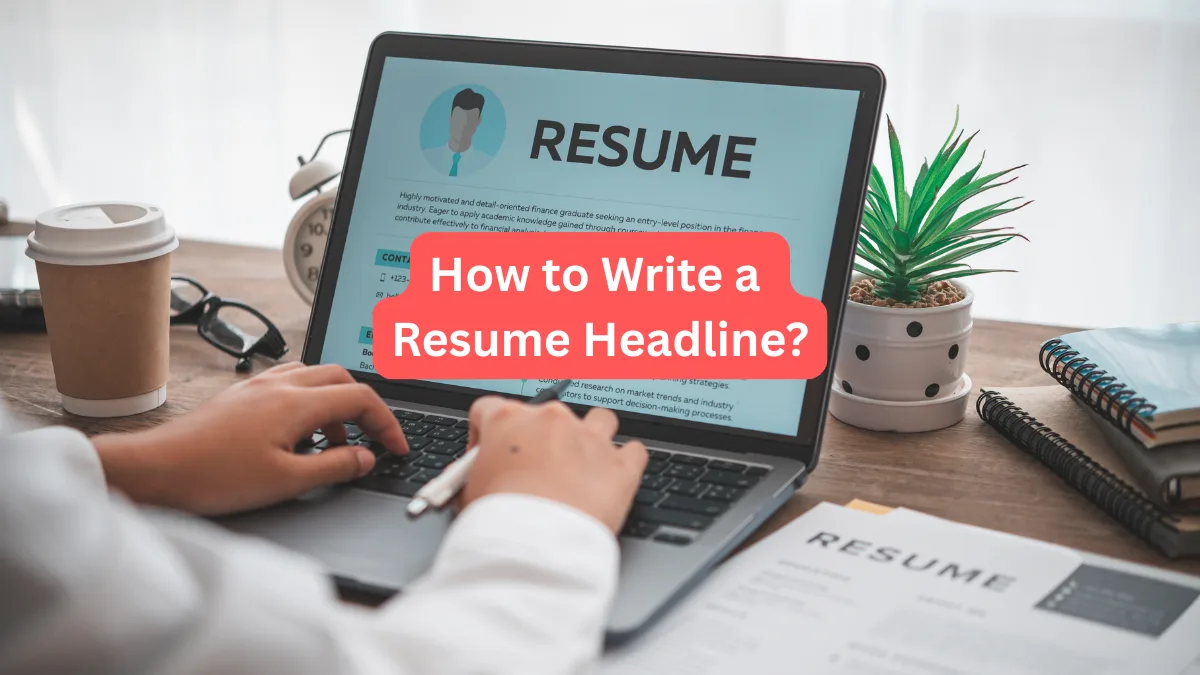
Learning how to write a resume headline is one of the highest-return improvements you can make to your resume. A headline sits at the top of your resume, directly below your name and contact details, and gives a hiring manager an immediate read on who you are professionally. It is the first thing they see, and in a stack of dozens of resumes, a sharp headline creates the kind of first impression that keeps them reading.
Most candidates skip the headline entirely or replace it with a vague objective statement that adds nothing. Both are missed opportunities. A well-written resume headline tells the recruiter your job title, your strongest qualifier, and your professional identity in under ten words. This article walks through exactly how to write a resume headline that is specific, ATS-friendly, and relevant to the role you are targeting.
Must Read: What is a Headline on a Resume?
To write a resume headline, combine your job title, a key qualifier such as years of experience or a top skill, and one specific credential or result. Keep it to one line and five to ten words. Place it directly below your contact information. Tailor it to each job posting.
What Is a Resume Headline and Why Does It Matter
A resume headline is a short phrase at the top of your resume that labels your professional identity. Think of it like a newspaper headline: it delivers the most important information first and pulls the reader in.
Hiring managers spend an average of seven seconds on an initial resume scan, according to a 2018 eye-tracking study by Ladders Inc. Your headline is one of the first elements their eyes hit. A clear, specific headline anchors everything that follows and frames how the reader interprets your experience.
A resume headline also helps with applicant tracking systems. ATS software scans the top section of your resume first. When your headline includes the job title and relevant keywords from the posting, your resume scores higher in ATS ranking before a human ever reads it.
How to Write a Resume Headline: The Core Formula
The most reliable way to write a resume headline follows a simple three-part structure:
[Job Title] | [Years of Experience or Credential] | [Top Skill or Qualifier]
Examples using this formula:
- Senior Product Manager | 8 Years | SaaS & Agile Product Development
- Registered Nurse | ICU & Critical Care | 6 Years Experience
- Data Analyst | Python & Tableau | Healthcare Industry
- Digital Marketing Manager | SEO, Paid Media & B2B Lead Generation
- CPA | Corporate Tax & Compliance | Big 4 Background
Each example is specific, concrete, and scannable. None use vague descriptors. All tell the hiring manager exactly who the candidate is within three seconds of reading.
Step-by-Step: How to Write a Resume Headline
Follow these steps in order to produce a headline that works for your specific situation.
- Start with your target job title. Use the exact job title from the posting when it matches your background. If the posting says “Marketing Manager” and your last title was “Marketing Lead,” align toward the posting’s language. This improves ATS matching.
- Add your most relevant credential. This can be years of experience, a certification, an industry, a degree, or a notable company name. Pick the one qualifier that most directly answers what the employer is looking for.
- Include one high-value skill or area of expertise. Look at the job description. What skill or tool appears most prominently? If you have it, include it in your headline.
- Keep it to one line. Ten words or fewer is the target. Two lines are acceptable for senior roles with multiple important qualifiers. Three lines is too much.
- Remove filler words. Drop adjectives like “dynamic,” “passionate,” “results-driven,” and “innovative.” They take space and say nothing. Concrete nouns and skills do the work instead.
- Tailor it per application. A headline that works for one job posting may be off for another. Spend two minutes adjusting it each time you apply. The specificity signals genuine interest and effort.
- Check ATS compatibility. Write the headline in plain text. No text boxes, graphics, or unusual formatting. ATS systems parse plain text reliably. Fancy formatting causes parsing errors that bury your resume.
Resume Headline vs Resume Summary: What Is the Difference
Many candidates confuse these two sections or try to use them interchangeably. They serve different purposes and both can coexist on the same resume.
| Feature | Resume Headline | Resume Summary |
|---|---|---|
| Length | 5 to 10 words | 3 to 5 sentences |
| Format | Single phrase or label | Short paragraph |
| Purpose | Identify your professional identity instantly | Explain your background and value |
| Placement | Directly below contact info | Below the headline |
| Bullet points | No | Sometimes |
| Customization | Tailored to job title and keywords | Tailored to role and company |
| Read first | Yes | Second, after headline |
Use both when possible. The headline grabs attention. The summary builds the case. Together, they form a strong opening section that gives the recruiter everything they need to decide your resume is worth a full read.
Also Read: Is Medical Device Sales a Good Career? (Honest Breakdown)
How to Write a Resume Headline for Different Career Stages
Knowing how to write a resume headline changes depending on where you are in your career. The formula stays the same, but the emphasis shifts.
Entry-Level Candidates
Lead with your degree, field of study, or a relevant certification. Do not apologize for limited experience. Focus on your strongest relevant qualification.
- Marketing Graduate | Social Media & Content Creation | Google Analytics Certified
- Recent Finance Graduate | Excel & Financial Modeling | CFA Level 1 Candidate
- Computer Science Graduate | Python & Java | Full-Stack Development Focus
Mid-Career Professionals
Emphasize your title, years of experience, and primary area of expertise. This group has the most options because they can combine strong credentials with specific skills.
- Operations Manager | 7 Years | Lean Six Sigma Black Belt
- Account Executive | SaaS Sales | Consistent 120%+ Quota Attainment
- HR Business Partner | Talent Management & Employee Relations | 9 Years
Senior and Executive Candidates
Focus on scope, impact, and industry weight. Senior headlines often reference revenue, team size, or organizational scale rather than individual skills.
- Chief Marketing Officer | B2B Tech | $50M+ Revenue Growth Leadership
- VP of Operations | Global Supply Chain | 15 Years Manufacturing Industry
- Director of Engineering | 200-Person Engineering Org | Cloud Infrastructure & DevOps
Career Changers
Connect your transferable skills to your new target role. Be direct about the pivot without over-explaining it. The cover letter handles the full explanation.
- Former Teacher Transitioning to Corporate L&D | Curriculum Design & Facilitation
- Military Veteran | Project Leadership & Logistics | Targeting Operations Management
- Nurse Practitioner Moving into Healthcare Consulting | Clinical Operations & Quality
Resume Headline Examples by Industry
The right headline content varies by field. Here are targeted examples showing how to write a resume headline across common industries.
Technology
- Software Engineer | React & Node.js | 5 Years Full-Stack Development
- DevOps Engineer | AWS & Kubernetes | CI/CD Pipeline Architecture
- Product Designer | Figma & User Research | Mobile-First SaaS Products
Finance and Accounting
- Senior Financial Analyst | FP&A & Forecasting | Manufacturing Sector
- Controller | GAAP Compliance & Month-End Close | Private Equity-Backed Companies
- Investment Banking Analyst | M&A & Capital Markets | 3 Years Bulge Bracket
Healthcare
- Physical Therapist | Orthopedic & Sports Rehabilitation | Outpatient Setting
- Healthcare Administrator | Hospital Operations & Regulatory Compliance | 10 Years
- Clinical Research Coordinator | Phase II to IV Trials | Oncology Focus
Marketing and Creative
- Brand Strategist | Consumer Packaged Goods | Campaign Strategy & Market Research
- SEO Specialist | Technical SEO & Content Strategy | eCommerce Industry
- Copywriter | B2B SaaS | Long-Form Content & Email Sequences
Sales
- Enterprise Sales Executive | CRM & ERP Solutions | 8 Years Fortune 500 Accounts
- Business Development Manager | Channel Partnerships | SaaS Revenue Growth
- Inside Sales Representative | SDR to AE Progression | Tech Startup Environment
Education
- High School Biology Teacher | STEM Integration & AP Curriculum | 12 Years
- Instructional Designer | eLearning Development & LMS Administration | Corporate Training
- School Counselor | College Advising & Social-Emotional Learning | K-12
Legal
- Litigation Paralegal | Civil & Commercial Disputes | 6 Years Law Firm Experience
- Contract Manager | SaaS Agreements & Vendor Negotiations | Technology Sector
- Compliance Officer | AML & BSA Regulations | Financial Services Industry
Common Mistakes to Avoid When Writing a Resume Headline
Understanding how to write a resume headline includes knowing what actively hurts your chances.
- Using buzzwords instead of specifics. “Results-driven professional” and “strategic thinker” are placeholders. Every candidate says this. Replace them with your actual title and skills.
- Writing a complete sentence. A headline is a label, not a sentence. It does not need a verb. “I am a senior engineer with experience in cloud systems” is a summary opener, not a headline.
- Making it too long. A headline that runs to three lines loses its punch entirely. If you cannot say it in ten words, edit harder.
- Leaving it generic. “Sales Professional” tells the hiring manager almost nothing. “B2B SaaS Sales Manager | Mid-Market Accounts | 6 Years” tells them exactly who you are.
- Not updating it per application. The same headline sent to every employer regardless of role is a missed opportunity. Tailor the job title and key skills to each posting.
- Skipping it altogether. Some candidates jump straight from contact information to a summary. Adding a headline takes two minutes and significantly improves the visual hierarchy and ATS performance of your resume.
- Using personal pronouns. Do not write “I am a” or “Experienced professional who.” Headlines drop pronouns entirely. Just state the title and qualifier directly.
How ATS Systems Read Your Resume Headline
When you learn how to write a resume headline, ATS compatibility is not optional. Most mid-to-large employers use ATS software to filter resumes before human review. The headline is parsed early in that process.
To optimize for ATS:
- Write in plain text with no special characters, symbols, or formatting tricks
- Use the exact job title from the posting when it matches your background
- Include primary keywords from the job description naturally within the headline
- Avoid using pipes or separators that some ATS systems cannot parse correctly (test with a simple version if unsure)
- Do not place your headline inside a text box, header section, or table in your word processor, as these elements are often invisible to ATS parsers
A headline that reads clearly to a human and parses correctly for ATS is the goal. When both conditions are met, your resume performs better at every stage of the screening process.
How to Test Your Resume Headline
Before you submit, run your headline through this quick checklist:
- Does it include your target job title or a close match to it?
- Does it contain at least one specific skill, certification, or credential?
- Is it ten words or fewer?
- Are there any filler adjectives to cut?
- Does it mirror language from the job posting?
- Would a stranger know your professional identity from this line alone in three seconds?
- Is it written in plain text with no formatting that could confuse ATS?
If all seven boxes are checked, the headline is ready. If any are unchecked, revise before submitting.
Frequently Asked Questions
How long should a resume headline be?
Five to ten words is the ideal length. One line is the target. Two lines work for senior professionals with multiple key qualifiers. Beyond two lines, the headline loses its visual impact and starts competing with your summary for space and attention.
Should I use the same resume headline for every job application?
No. Tailor your headline to each posting. Adjust the job title to match the posting’s language and include the most relevant keyword or skill for that specific role. A customized headline improves both ATS ranking and the impression it makes on the hiring manager who reads it.
Can a resume headline include certifications?
Yes, certifications are strong headline qualifiers. Examples: “PMP-Certified Project Manager | IT Infrastructure & Agile,” or “CPA | Corporate Tax Compliance | Big 4 Background.” Include a certification when it is directly relevant to the role and recognized in your industry.
What is the difference between a resume headline and a resume objective?
A resume headline is a short label identifying who you are professionally. A resume objective is a sentence or two stating what you want from a job. Headlines are more effective for most candidates. Objectives are now considered outdated except for entry-level candidates or career changers who need to explain their direction.
Should entry-level candidates include a resume headline?
Yes. Entry-level candidates benefit from a headline because it immediately signals their target role and strongest qualification. Without one, the hiring manager has to search the resume for context. Focus on degree, relevant skills, or a certification rather than years of experience.
Where exactly does the resume headline go?
Place it directly below your name and contact information, above your resume summary or the first section of your resume. It should be the first professional content the reader sees. Bold it or use a slightly larger font size so it stands out visually from the body text.
Conclusion
Knowing how to write a resume headline is a practical, learnable skill that takes minutes to apply and meaningfully improves your resume’s performance. Start with your job title, add your strongest qualifier, include one specific skill or credential, and keep it under ten words. Tailor it to each posting and write it in plain text so ATS systems read it cleanly.
A sharp headline does not guarantee an interview. But it makes the recruiter more likely to keep reading, and that is exactly the job it needs to do.



Leave a Comment