
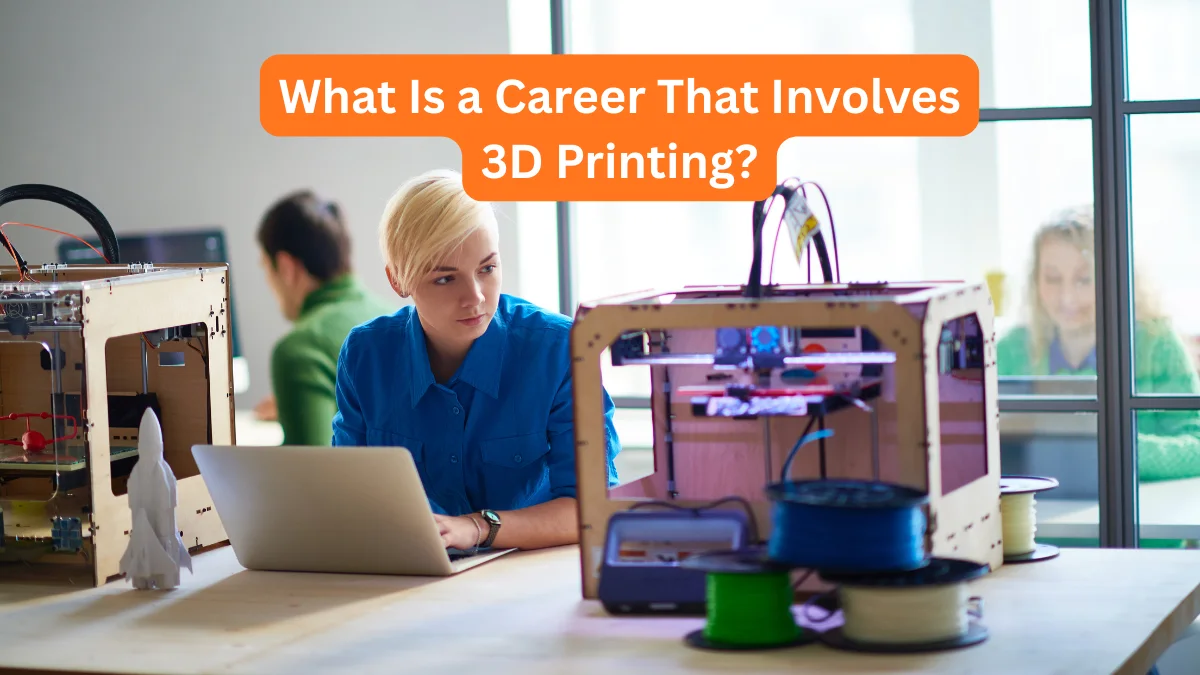
If you are asking what is a career that involves 3D printing, you are looking at one of the fastest-growing skill sets across manufacturing, healthcare, engineering, design, and construction. 3D printing, formally called additive manufacturing, has moved well beyond hobbyist use. It now sits at the core of product development pipelines at aerospace companies, surgical planning in hospitals, custom prosthetics labs, and automotive prototyping facilities. The people who operate, design for, and develop these systems are in genuine and growing demand.
The global 3D printing market was valued at $18.33 billion in 2022 and is projected to grow at a compound annual growth rate of 23.3% through 2030, according to Grand View Research. That growth rate signals a technology moving from early adoption to mainstream industrial integration. Careers built around this technology now offer competitive salaries, clear advancement paths, and cross-industry applicability that most technical skills cannot match.
Also Check: Is Nursing a Good Career in 2026? Real Challenges & Pros
Careers that involve 3D printing include additive manufacturing engineer, CAD designer, biomedical engineer, industrial designer, materials scientist, aerospace technician, and product development specialist. These roles exist across healthcare, aerospace, automotive, architecture, and consumer goods. Salaries range from $45,000 for entry-level technicians to over $120,000 for senior engineers.
What Is a Career That Involves 3D Printing: The Full List
The range of careers connected to 3D printing is broader than most people expect. Some roles center entirely on additive manufacturing. Others use it as one tool within a larger technical skill set. Here is a structured overview:
| Job Title | Primary Industry | Median Salary (US) | Education Required |
|---|---|---|---|
| Additive Manufacturing Engineer | Aerospace, Defense, Auto | $85,000 to $120,000 | Bachelor’s in Engineering |
| CAD / 3D Modeling Designer | Manufacturing, Product Design | $55,000 to $85,000 | Associate’s or Bachelor’s |
| Biomedical Engineer | Healthcare, Medical Devices | $97,410 (BLS 2023) | Bachelor’s in Biomedical Eng |
| Industrial Designer | Consumer Goods, Furniture | $72,090 (BLS 2023) | Bachelor’s in Industrial Design |
| Materials Scientist | R&D, Aerospace, Medical | $99,460 (BLS 2023) | Bachelor’s or Master’s |
| 3D Printing Technician | Manufacturing, Service Bureaus | $45,000 to $65,000 | Associate’s or Certification |
| Mechanical Engineer | Automotive, Aerospace | $96,310 (BLS 2023) | Bachelor’s in Mechanical Eng |
| Prosthetist / Orthotist | Healthcare, Rehabilitation | $77,030 (BLS 2023) | Master’s + Certification |
| Architectural Technologist | Construction, Architecture | $55,000 to $80,000 | Bachelor’s in Architecture |
| Research Scientist (AM Focus) | Academia, R&D Labs | $85,000 to $130,000 | Master’s or PhD |
| Quality Control Engineer | Manufacturing | $75,000 to $100,000 | Bachelor’s in Engineering |
| Product Development Specialist | Consumer Products, Startups | $70,000 to $100,000 | Bachelor’s, varies by field |
All salary data is drawn from BLS 2023 Occupational Outlook Handbook and industry salary surveys from Glassdoor and LinkedIn Salary Insights.
What Is a Career That Involves 3D Printing in Engineering
Engineering roles represent the highest concentration of 3D printing careers and the strongest salary outcomes.
Additive Manufacturing Engineer
This role sits at the center of what is a career that involves 3D printing in an industrial context. Additive manufacturing engineers design parts specifically for 3D printing production, select materials, optimize print parameters, and troubleshoot quality issues. They work closely with design teams and production floors in aerospace, defense, automotive, and medical device companies.
Key responsibilities:
- Design parts using design-for-additive-manufacturing (DFAM) principles
- Select appropriate printing technologies: FDM, SLA, SLS, DMLS, or binder jetting
- Validate printed parts against engineering specifications
- Develop post-processing workflows including finishing, heat treatment, and inspection
- Collaborate with quality control and supply chain teams
Major employers include Boeing, Lockheed Martin, GE Additive, Raytheon, Stratasys, and 3D Systems. Entry-level positions at these companies typically start between $70,000 and $85,000.
Mechanical Engineer with Additive Manufacturing Specialization
Most mechanical engineers now use 3D printing as part of their prototyping and production toolkit. Those who develop deep expertise in additive manufacturing become significantly more valuable to employers across all manufacturing industries. The BLS reports median annual pay for mechanical engineers at $96,310, with AM specialists commanding above-median compensation.
Materials Scientist
Materials scientists in additive manufacturing research and develop the filaments, resins, metal powders, and composite materials used in 3D printing systems. This is a research-heavy role common in aerospace, medical devices, and academic settings. New material development is one of the primary constraints on what 3D printing can produce, making this specialty central to the field’s advancement.
What Is a Career That Involves 3D Printing in Healthcare
Healthcare is one of the most active and growing areas for 3D printing career development.
Biomedical Engineer
Biomedical engineers who specialize in additive manufacturing design custom implants, surgical guides, anatomical models for pre-surgical planning, and patient-specific prosthetics. Hospitals including Mayo Clinic, Cleveland Clinic, and NYU Langone now operate dedicated 3D printing labs staffed by biomedical engineers and imaging specialists.
The FDA has approved hundreds of 3D-printed medical devices, and the volume of approved devices grows annually. This regulatory momentum creates sustained employment demand for engineers who understand both the clinical application and the manufacturing process.
Prosthetist and Orthotist
Custom prosthetics and orthotic devices represent one of the clearest and most immediate applications of 3D printing in patient care. Certified prosthetists and orthotists who incorporate 3D printing into their practice can produce custom-fit devices faster and at lower cost than traditional fabrication methods. The BLS reports median annual pay of $77,030 for this role, with demand growing as the technology makes custom devices more accessible.
Clinical 3D Printing Specialist
A newer role emerging at major hospital systems, clinical 3D printing specialists manage the hospital’s additive manufacturing lab, process medical imaging data into printable files, and work with surgical teams to produce anatomical models and surgical planning tools. This role typically requires a background in biomedical engineering, radiology, or a related clinical field combined with hands-on 3D printing expertise.
What Is a Career That Involves 3D Printing in Design and Architecture
Industrial Designer
Industrial designers who know how to model and prototype using 3D printing move faster from concept to physical prototype than those working with traditional methods. Consumer electronics, furniture, footwear, and household goods companies all use 3D printing extensively in their product development cycles. Nike, Adidas, and New Balance have used 3D printing to produce custom midsoles and performance footwear components.
The BLS reports median annual wages for industrial designers at $72,090. Designers with strong CAD skills in tools like SolidWorks, Rhino, or Fusion 360 alongside 3D printing knowledge command above-median compensation.
CAD Designer and 3D Modeler
Every 3D printed object starts as a digital model. CAD designers and 3D modelers create those files. What is a career that involves 3D printing at the most accessible entry point often starts here. Associate’s degree programs and certification courses in CAD modeling and 3D printing can qualify candidates for technician and designer roles within one to two years.
Core software knowledge for this role:
- Autodesk Fusion 360
- SolidWorks
- Rhino 3D
- Blender (for organic modeling)
- Autodesk Inventor
- PTC Creo
Architectural Technologist
Architecture firms increasingly use 3D printing for scale model production, complex facade prototyping, and client presentation models. Construction companies are moving further, using large-format concrete printing systems to print structural building components. Architectural technologists with additive manufacturing skills work across design studios, construction firms, and specialized 3D printing service companies.
What Is a Career That Involves 3D Printing in Aerospace and Defense
Aerospace is arguably the most advanced industry in 3D printing adoption. GE Aviation produces fuel nozzles for the LEAP jet engine using metal additive manufacturing. NASA and SpaceX use printed components in rocket engines and structural assemblies.
Careers in this sector that directly involve additive manufacturing include:
- Aerospace Manufacturing Engineer focused on metal powder bed fusion and directed energy deposition processes
- Quality Assurance Engineer specializing in non-destructive testing of printed aerospace components
- Process Development Engineer optimizing print parameters for titanium, Inconel, and other aerospace-grade alloys
- Supply Chain Engineer managing additive manufacturing as an alternative to traditional supplier networks for low-volume or legacy parts
- Research Engineer working on next-generation materials and printing processes at national labs or defense contractors
Security clearances are often required for defense-sector roles. Compensation in aerospace additive manufacturing reflects that requirement, with experienced engineers regularly earning $110,000 to $140,000 or more.
Entry Paths Into 3D Printing Careers
What is a career that involves 3D printing as a starting point for someone without a four-year engineering degree? More accessible than most people realize.
3D Printing Technician The most direct entry-level role. Technicians operate printers, prepare files for printing, perform post-processing, and maintain equipment. Many positions hire candidates with an associate’s degree or a certificate in additive manufacturing, CAD, or a related technical field. Salary range: $40,000 to $65,000.
CAD Drafting Technician Entry-level modeling roles focused on converting design concepts into printable files. Community college programs and online certifications through Autodesk, Coursera, and LinkedIn Learning provide sufficient training for many entry positions.
Service Bureau Operator Companies like Shapeways, Xometry, and Protolabs operate 3D printing service bureaus that take client files and produce parts at scale. These companies hire operators, quality technicians, and customer-facing application engineers, many of whom are trained on the job.
Academic and Maker Space Technician Universities, libraries, and maker spaces hire technicians to manage shared 3D printing facilities. These roles often pay less than industry positions but provide hands-on experience across multiple technologies and user applications, making them strong entry points into the field.
Skills That Employers Look For in 3D Printing Careers
Across job postings in additive manufacturing, the following skills appear most frequently:
- CAD proficiency in one or more major platforms
- Knowledge of print technologies: FDM, SLA, SLS, DMLS, PolyJet, binder jetting
- Material knowledge: polymers, resins, metal powders, composites
- Post-processing techniques: sanding, painting, heat treatment, machining
- Quality inspection methods: calipers, CMM, CT scanning for printed parts
- Design for additive manufacturing (DFAM) principles
- File preparation software: Materialise Magics, Simplify3D, Cura, PreForm
- Problem-solving and troubleshooting: diagnosing print failures and parameter errors
- GD&T (Geometric Dimensioning and Tolerancing): for engineering roles
- Regulatory knowledge: FDA guidelines for medical devices, AS9100 for aerospace
Education Pathways for 3D Printing Careers
| Education Level | Time Required | Best For | Cost Range |
|---|---|---|---|
| Online certification (Coursera, Udemy) | 1 to 6 months | Career switchers, hobbyists entering industry | $50 to $500 |
| Community college certificate | 6 to 12 months | Technician and operator roles | $3,000 to $8,000 |
| Associate’s degree (AM or CAD) | 2 years | Entry engineering tech roles | $8,000 to $20,000 |
| Bachelor’s in Engineering or Design | 4 years | Engineer, designer, specialist roles | $40,000 to $120,000+ |
| Master’s degree (AM or Materials) | 2 years post-bachelor | Research, senior engineering, academic | $20,000 to $60,000 |
| PhD | 4 to 6 years post-bachelor | Research scientist, faculty, advanced R&D | Typically funded |
Several universities now offer dedicated additive manufacturing programs or concentrations, including Penn State, Georgia Tech, and the University of Louisville’s Additive Manufacturing Institute.
Industry Outlook for 3D Printing Careers
The long-term trajectory for careers in additive manufacturing is positive for several concrete reasons:
- Supply chain disruption during the COVID-19 pandemic accelerated adoption of on-demand 3D printing as an alternative to traditional manufacturing and overseas sourcing
- US Department of Defense investment in additive manufacturing for military readiness and spare parts production continues to grow
- FDA approval of 3D-printed pharmaceuticals, surgical implants, and medical devices is expanding the healthcare market
- Construction-scale 3D printing is moving from pilot projects to commercial deployment in residential and infrastructure applications
- The push for lightweighting in electric vehicles is increasing automotive industry investment in printed structural components
These are not speculative trends. They represent active capital investment and policy support that directly create employment for people who build careers in additive manufacturing.
Frequently Asked Questions
Do you need an engineering degree for a 3D printing career?
Not always. Technician and operator roles are accessible with an associate’s degree or certificate. Engineer, materials scientist, and design roles typically require a bachelor’s degree or higher. Your target role determines your required education level rather than the technology itself requiring a specific credential.
What software should I learn for a 3D printing career?
Start with Autodesk Fusion 360 or SolidWorks for CAD modeling. Learn a slicing software like Ultimaker Cura or Simplify3D for FDM printing. For professional environments, Materialise Magics is widely used. The right software depends on your target industry and the printing technologies used there.
Is 3D printing a stable career long-term?
Yes, based on current market data. The additive manufacturing market is projected to grow at 23.3% CAGR through 2030. Industrial adoption is accelerating across aerospace, healthcare, and automotive. Skills in additive manufacturing are transferable across industries, which adds stability compared to single-industry technical specializations.
What is the highest-paying career involving 3D printing?
Materials scientists, aerospace additive manufacturing engineers, and senior biomedical engineers with additive specialization are among the highest earners, typically in the $110,000 to $140,000+ range. CRNAs who use 3D-printed surgical guides and research scientists at national labs also reach the upper end of this salary range.
Can I get a 3D printing job without a degree?
Yes, at the technician and operator level. Strong hands-on experience, a portfolio of printed projects, and certifications from platforms like Coursera, Autodesk, or the Additive Manufacturing Users Group (AMUG) can substitute for a degree in some entry-level hiring situations, particularly at smaller companies and service bureaus.
Which industries hire the most 3D printing professionals?
Aerospace and defense, healthcare and medical devices, automotive, consumer goods, and architecture hire the most professionals in additive manufacturing roles. Service bureaus like Xometry, Protolabs, and Materialise also represent a growing employer category specifically focused on 3D printing as a core business.
Conclusion
What is a career that involves 3D printing is a question with a wide and practical answer. The technology now touches engineering, healthcare, design, construction, and defense, and each of those fields employs specialists who work with additive manufacturing daily. Entry points exist at the certificate and associate’s degree level, and the career ceiling reaches into six-figure engineering and research roles.
Build relevant CAD and materials skills, choose the industry that aligns with your background, and treat additive manufacturing expertise as a long-term investment. The field is growing and the demand for qualified people is real.











Leave a Comment